Software — vtest

Validation Testing

How many samples, which tests, how long, how much.

Early release 0.1.0 vtest — command line and desktop app

What it does

Plans the environmental and mechanical qualification a product needs for its industry, markets and mounting location — the sample matrix, the test legs, the schedule and the cost, with traceability back to the requirement that demanded each test.

  • Applicable tests from ISO 16750, IEC 60068, DO-160, IEC 60601 and their relatives
  • Temperature, humidity, vibration, shock, drop, IP, IK, salt spray, altitude and supply-voltage tests
  • Sample matrix and test legs, with sample counts that actually support the schedule
  • Equipment list, costs, resource loading and a dated schedule
  • Reads requirements from DOORS, DOORS Next, Polarion and Jama as ReqIF (.reqif and .reqifz), or from CSV
  • Schedules with equipment levelling, so two tests do not both claim the only chamber
  • Requirement traceability back out to ReqIF and CSV
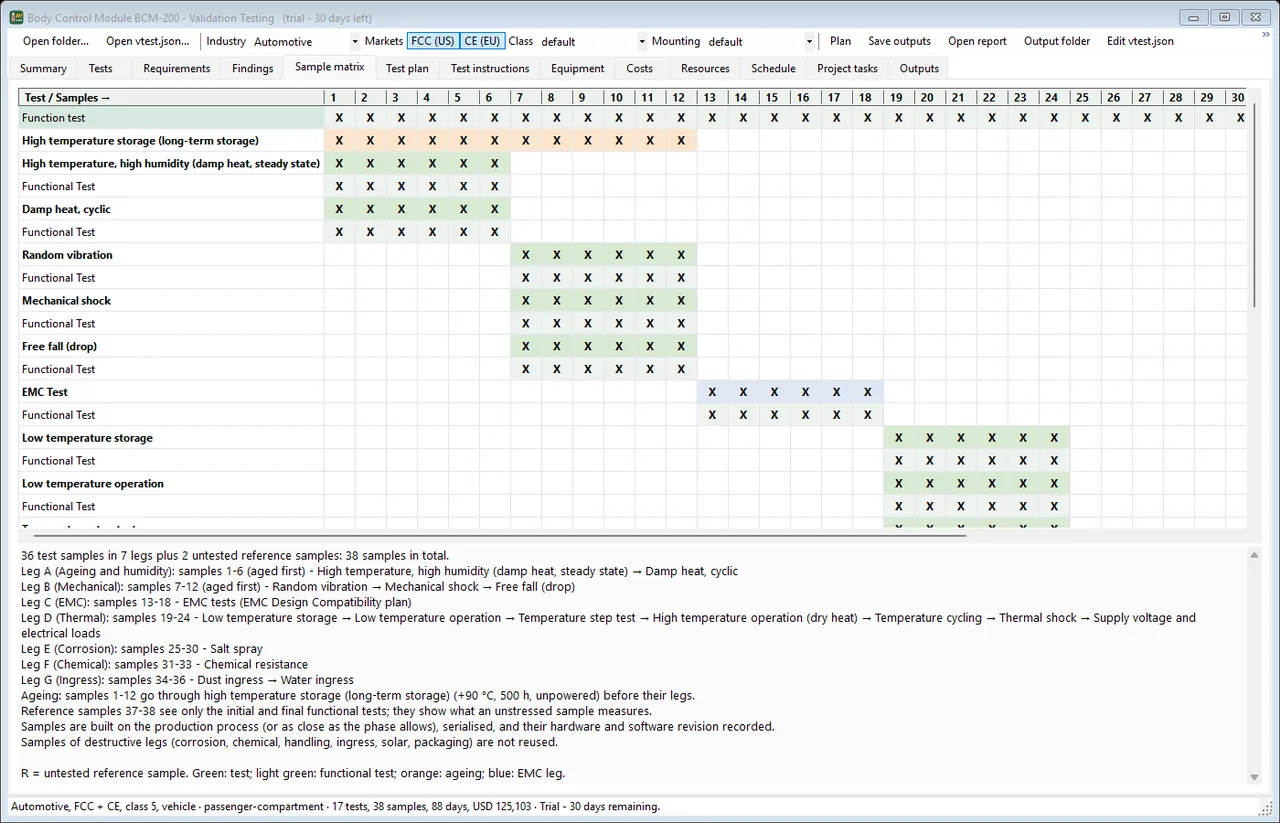
The sample matrix: which units go down which test leg, and how many are needed for the legs to run in parallel.
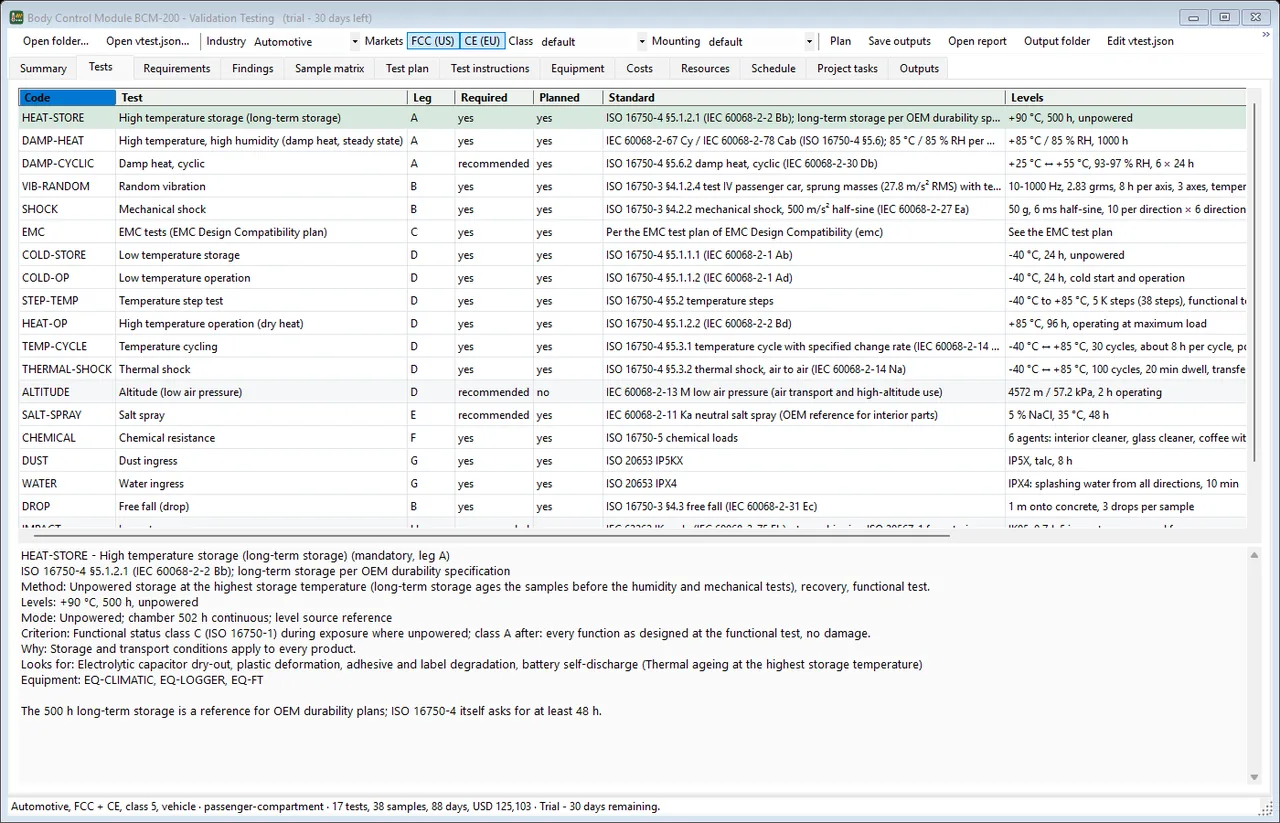
Seventeen tests worked out for an automotive body control module in the passenger compartment, each with the standard that demands it, the leg it runs on and the exact level. The pane below one of them is the part a plan usually leaves out: not just +90 degC for 500 h unpowered, but the functional status class required during and after exposure, and what the test is actually looking for - electrolytic dry-out, plastic deformation, adhesive and label degradation. The footer totals it: 38 samples, 88 days, USD 125,103.
Requirements read from an OEM specification and a ReqIF file, each matched to the tests that verify it - and flagged where it does not hold up. BELOW-STANDARD on a salt spray requirement that asks for less than the standard does, NO-LEVEL where a requirement names no number to test against, VERIFY-BY-ANALYSIS where no test can settle it, and NO-REQUIREMENT on a test the tool suggests that nothing has asked for. Those flags are the gaps a review usually finds far too late.
The same plan costed to the line: USD 125,103, broken down by category and again by test leg, with every charge shown as quantity times rate - 502 hours of climatic chamber at 25 an hour, the technician hours beside it. Equipment is two thirds of the bill, which is the number that decides whether a test goes to a laboratory or stays in-house.
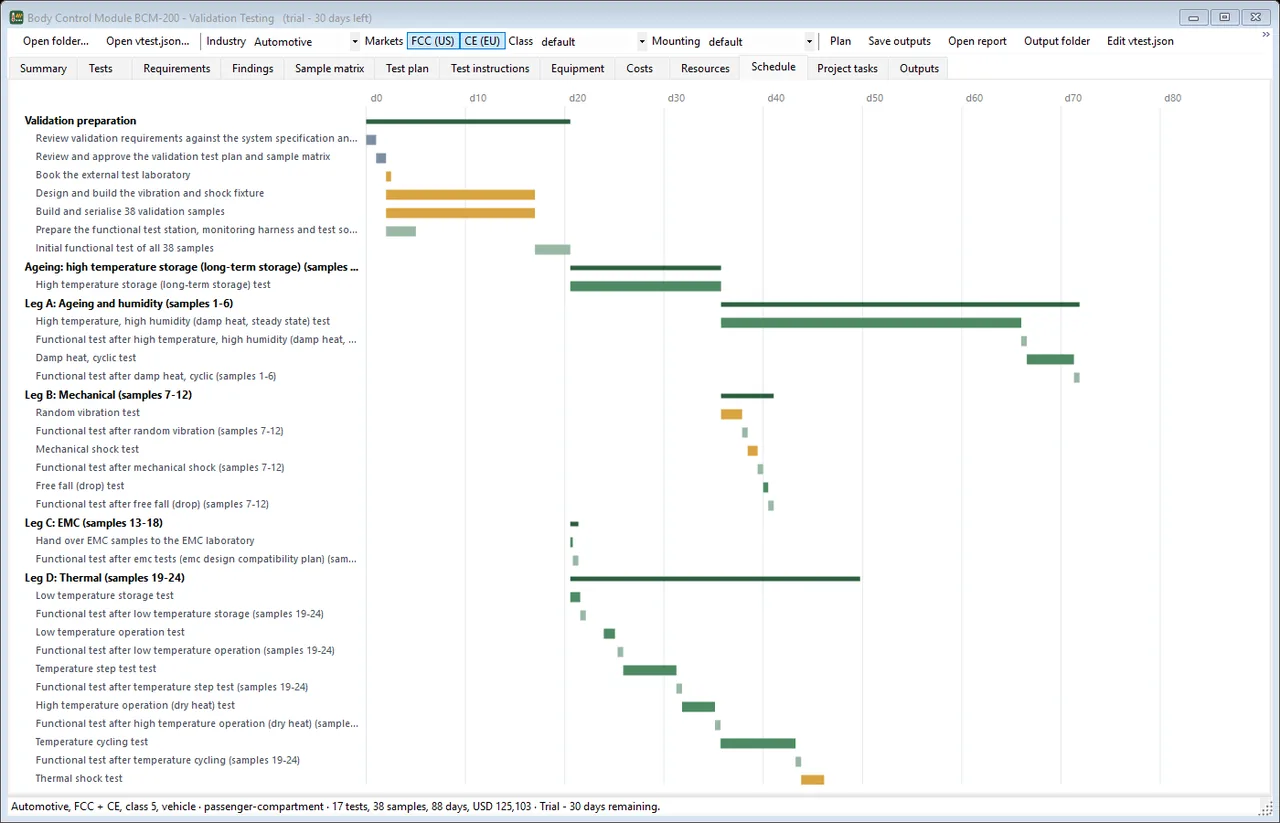
Why the sample count matters, drawn as a schedule. The four legs - ageing and humidity, mechanical, EMC and thermal - run in parallel on their own sets of samples, which is the only way 88 days is possible. Build too few samples and these bars go end to end instead, and a quarter disappears. The functional test after every exposure is scheduled too, because that is what proves the sample still works.

On video

One recording of it actually running.

A screenshot of a program that moves is only half of it, so here it is moving. Recorded off the screen while it ran on this bench - its own window, its own example project, nothing staged. The verdicts are whatever the application returned. Nothing plays until you press it.

30 s An automotive body control module planned from its profile: 17 tests, 7 legs, 38 samples, 2335 chamber hours, 88 working days and USD 125,103. The sample matrix showing which units go down which leg, the cost broken to the line, and the schedule drawn as a Gantt with all seven legs running on their own samples.

Get in touch

Validation Testing is not a download. It is one of the tools the work is done with, installed and licensed when an engagement starts. Tell me what you are working on and I will tell you what it would do for it.

Or email mblab.technology@gmail.com. Your details are used to answer you and to follow up — nothing else.

Requirements

  • Windows 10 or 11, 64-bit
  • About 200 MB of disk
  • No .NET install needed — the runtime is bundled
  • No Excel needed — workbooks are written directly

Also in the set