Cost and effort
The documents are not the work. Agreeing on them is.
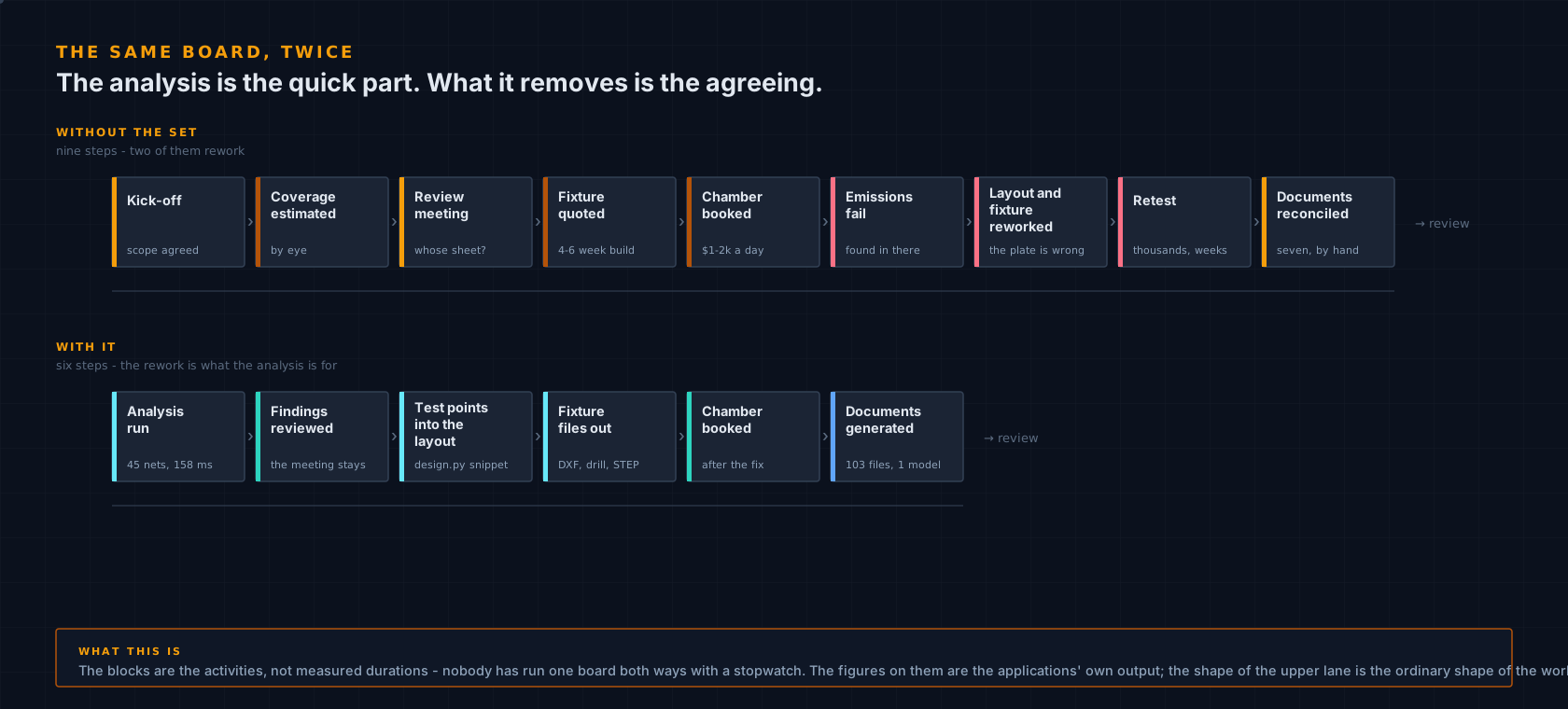
A test plan, a test specification, per-setup instructions, a DFT report, a risk analysis, a coverage workbook, an equipment list and a project plan. Writing those is a week. Getting seven of them to agree with each other, and keeping them agreeing after the layout moves, is the rest of the quarter — and it is spent almost entirely in meetings, and in finding out whose copy is current.
Read this part first Nobody has run the same board through the same project twice, once with these applications and once without, with a stopwatch. So this page does not contain a percentage, and it will not tell you what you would save. The one place on this site that names a multiplier is the whole-system page, and it says in the same breath that it is an opinion. Every number on it is either one of these applications' own output against one real board, or a cost already published on the page it came from. The column headed without describes the ordinary shape of the work, not a measurement of your team. If you have run it both ways, I would genuinely like your numbers — there is a note at the bottom of this page.
Question by question
The same seven questions, answered two ways.
| The question | Without the set | With it |
|---|---|---|
| Can a probe reach every net? | The fixture house finds out when it quotes, or the drilled plate finds out for you. An ICT fixture is a four-to-six week build and has to be reworked if the layout moves underneath it. | 62 parts and 45 nets analysed in 158 ms: 90.2 % coverage, the unreachable nets named, and three test points suggested that add 2.1 % each - as a paste-ready design.py snippet, so they go back into the layout instead of into a meeting. → |
| Who draws the fixture? | A drawing is marked up, sent out, quoted, revised, and drawn again after the layout changes. | It falls out of the same analysis, per plate and on one datum: a machining DXF, a dimensioned drawing, an Excellon drill file, hole centres as XYZ, a probe list with the net and target of every pin, the push-rod and force tables, the plate as a KiCad board, and a STEP model for the mechanical assembly. → |
| Will it pass emissions? | Book a chamber at roughly $1,000-2,000 a day and find out. A single retest cycle after a failure adds thousands and weeks. | A predicted failure 20.2 dB over the limit at 200 MHz, on your own bench, with the applicable standards worked out by industry and market and the fix chosen before the booking is made. → |
| How long is qualification, and what does it cost? | An estimate, defended in a meeting, and a sample count nobody checks until the samples have been built. | 17 tests, 38 samples, 88 days and USD 125,103, costed to the line - 502 hours of climatic chamber at an hourly rate with the technician hours beside it, and equipment coming out as two thirds of the bill. → |
| Do the four test legs really run in parallel? | They do if there are enough samples. Nobody finds out there are not until the schedule has already been promised. | A schedule that draws the four legs on their own sample sets - and draws them end to end instead when the sample count is short, which is where a quarter disappears. → |
| What do all of these say together? | Somebody reconciles a dozen reports by hand, in the week before the design review, and reconciles them again after the next change. | One run: 103 files, one report in three forms, 116 tasks and 558 hours merged into a single Microsoft Project plan, and 42 pieces of equipment reconciled across four applications. → |
| Do the documents still agree after the design changes? | No - and the meeting called to discover that is the expensive part. | Run it again. The test plan, the specification, the instructions, the DFT report, the risk analysis, the coverage workbook and the equipment list are twelve outputs of one trace model, so they agree by construction rather than by review. → |
| What does it take to automate the bench? | A test executive and a runtime to install on every station, and a driver written or bought for each instrument that does not already have one. | MBLT Sequencer imports the test plan's own legs and writes the sequence from its test cases, keeping each case's id on every result - then drives the instruments over what they already speak: SCPI on a socket or a serial line, Modbus TCP and RTU, VISA, and the HardwareRTD engine. It installs for one Windows user, and the station answers SCPI itself so a PLC can start a test. → |
| What does any of it need to run? | An account, a subscription, a cloud tenancy, and a network the laboratory may not be allowed to have. | A zip, an Install.bat and a machine. The .NET runtime is inside the package, there is no account, nothing is phoned home, and a bench with no route to the internet runs the whole set. → |
Every figure in the right-hand column is printed by the application linked beside it, running against the Z-Stack Controller Carrier — the board used as the worked example throughout this site.
Where the time actually goes
Four meetings you stop needing, and one you keep.
The one about whose spreadsheet is current
Seven documents written separately, by different people, at different times, have to be walked through line by line to find out where they disagree. Generated from one trace model they cannot disagree, so there is nothing to walk through.
The one about what the coverage probably is
Testability argued from experience, because measuring it by hand across 62 parts is a day nobody has. It is 158 ms, and the answer is a number with the unreachable nets listed underneath it.
The one after the chamber
A failure found in a rented chamber becomes an emergency review, a layout change, a fixture change and a second booking. Found on the bench it is an afternoon, and nobody else has to attend.
The one to rebuild the project plan
Tasks and equipment from four workstreams reconciled by hand into one schedule. The dispatcher merges them instead: 116 tasks, 558 hours, 42 pieces of equipment, one plan file.
And the one you keep — the one about the findings
None of this removes engineering judgement, and it should not try to. Whether 90.2 % coverage is good enough for this product, whether a 20.2 dB margin is worth a redesign or a shield, whether 38 samples can be built in time — those are decisions, and they want people in a room. The difference is that the room starts with the numbers already on the table, instead of spending its first hour working out what they are.
And it runs without anybody sitting there
Every one of them is a command-line program as well as a window.
pcbtest, emc, vtest,
tspec, aoi, mbvision,
mbctl and the rest take the same project and write the
same files from a script as they do from the desktop, and they
return an exit code. That is the part that changes the economics
rather than the ergonomics: a coverage check becomes a release gate
that can fail a build, a batch run covers every board in a folder,
and the analysis happens on the commit rather than in the week
somebody remembers to do it.
How the dispatcher chains them → · What each one speaks, in and out →
Being built now
The set is not only software.
The applications specify a fixture, a sequence, a bench and an enclosure. These are those things being built: the instrument a fixture bolts into, the tester that runs the functional leg, the sequencer that drives it, and the printer that makes the parts. None can be downloaded or bought yet, and none of them has anything to photograph. They are here because each one closes a gap you can already see in the pages above, and because saying what is coming is more useful than letting it arrive as a surprise. No dates — a date I miss is worse than no date at all.
Test equipment
In-circuit test equipmentBeing designed
The tester that the fixture files already describe.
What already exists. PCB Test Analysis already produces the whole fixture from the layout: a machining DXF of the plate, a dimensioned drawing, an Excellon drill file, hole centres as XYZ, a probe list with the net and target of every pin, the push-rod table, the force report, and a STEP model of the plate for the mechanical assembly. Those files go to a shop today.
What is missing. What is missing is the instrument the plate bolts into - the receiver and interface board, the switching matrix, and the measurement front end that reads what the probes touch. It is being designed against the boards on the hardware page, because those are the boards whose coverage has already been analysed.
Test equipment
Automated functional testersBeing designed
The bench that runs the functional leg, built as a unit.
What already exists. The functional test leg already exists on paper: Test Spec Ecosystem writes it out of the trace model as P-FT, with the cases, the limits and the equipment each one needs, and MBLT Sequencer can import that leg and run it. The instruments are reachable already - SCPI, Modbus, VISA, the HardwareRTD engine - and the simulated bench proves a sequence against faults before any hardware exists.
What is missing. The bench itself, as one thing rather than a trolley of borrowed instruments: a modular tester carrying programmable power, an electronic load, a relay matrix for routing, and the sensor and signal simulation a board needs to be exercised. It is being designed around the sequencer that would drive it and the fixtures the coverage analysis already specifies, which is the only reason to build it rather than buy one.
In-house manufacture
Rapid prototypingBeing set up
Enclosures, jigs and fixture plates made here, from the same files.
What already exists. The enclosures on the hardware page are drawn and exported - STEP for assembly, DXF for flat parts - and the fixture plates come out of the coverage analysis in the same formats. Laser engraving and fibre-laser copper ablation for prototype boards are already done in-house.
What is missing. What is being set up is printing them here rather than sending them out: enclosures, probe pods, panel parts, assembly jigs and fixture plates, on a day's turnaround instead of a week's. Until that is running, the hardware page says of every enclosure that it is designed and not yet printed, because it is.
An honest request
If you have run it both ways, tell me.
The weakest thing on this page is that the left-hand column is reasoning rather than measurement. The fix for that is not better writing, it is data. If you have taken a board through testability, EMC or qualification the old way and then again with any of these, I would like the two numbers — hours, or chamber days, or revisions of a fixture — and I will publish them with your name on them or without it, whichever you prefer. A page of real before-and-after figures would be worth more than everything above it.