Engineering tools for people who do not have a department behind them.
Test coverage before the fixture is cut. EMC pre-compliance before the chamber is rented. Validation planned before the samples are built — and then the schedule, the costed bill and the production test, generated from the same model instead of typed up afterwards. The whole arc a department covers, run by one engineer, or three, on a budget that was never going to stretch to the commercial answer.
What this is
Five things, and the thread between them.
Everything here started as something I needed on a particular afternoon and could not find at a price a one-person shop could justify. That is not a complaint about the commercial tools — they are good, and they are priced for companies with a department to put them in. It is an observation that there is a whole category of engineer the industry does not serve.
Applications for engineers
Testability and per-component test coverage, EMC pre-compliance against the standards that actually apply, environmental validation planning, requirements traceability, a KiCad driver and a full-wave field solver — plus the dispatcher that runs them in the right order and merges what comes back.
Seven applications → 02Test equipment
Software that behaves like an instrument on the bench: an oscilloscope that will plot anything able to send numbers, optical inspection driven over SCPI, a PLC and an HMI for boards that are not PLCs, and two ways of getting live instrument data into a spreadsheet while the rig is still running.
Nine applications → 03Documentation
Every application writes documents rather than printing results — test plans, test specifications and instructions, coverage workbooks, DFT and risk analysis, equipment lists, ReqIF for DOORS and a Microsoft Project plan. The deliverable is the point, not a screenshot of one — so one complete run is published here, unedited, for anybody to read.
What comes out → 04And they all talk to each other
Modbus TCP, OPC UA, MQTT, SCPI and plain sockets. Whatever reads a sensor re-serves the same value to the next machine, which can be on the same bench or on another continent. No cloud, no account, no broker to rent.
How they connect → 05The boards themselves
A USB oscilloscope front end, a carrier that turns an ESP32-S3 into a small PLC, isolated probes that let a sound card measure mains. Designed in KiCad from netlist-as-code with ERC, DRC and test coverage as release gates. All of them in the pipeline, and every one says so.
Seventeen boards →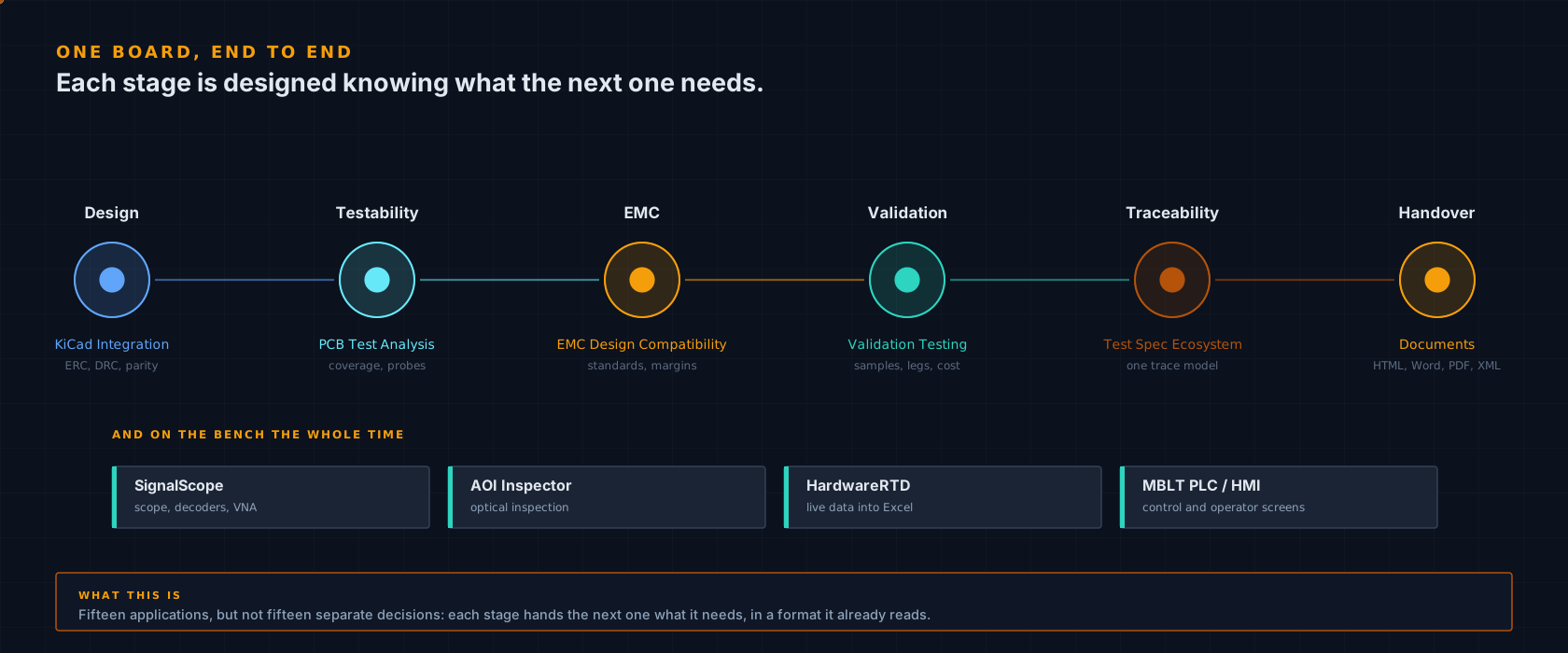
Why it is a system and not a drawer
The thread runs further than the engineering.
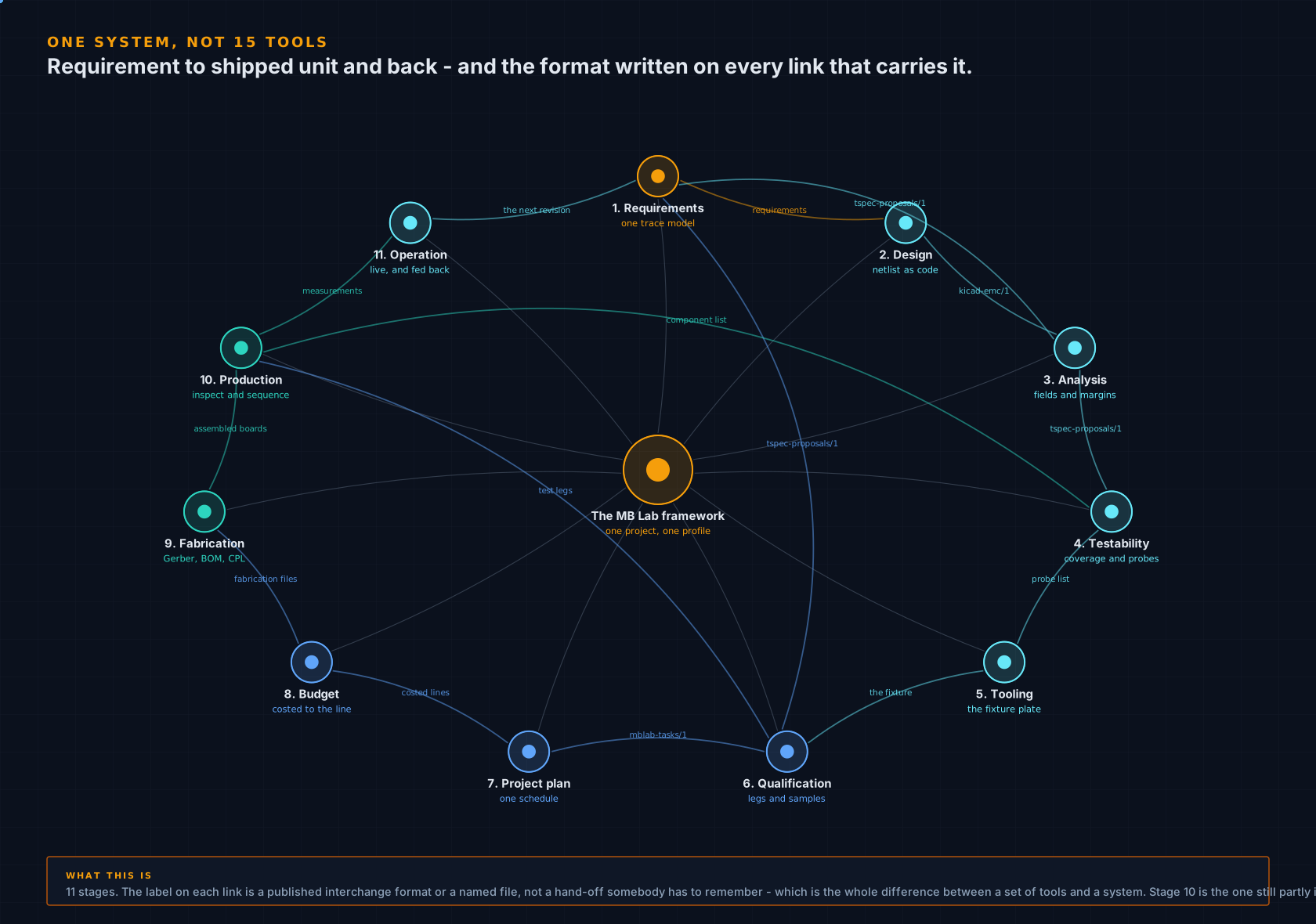
They share a product profile — industry, markets, product class, environment — and one project interface. A board analysed for testability hands its layout findings to the EMC analysis; EMC and validation both propose test cases into the traceability model; every one of them writes tasks that merge into a single Microsoft Project plan instead of a dozen unrelated reports. The dispatcher finds whatever is installed, works out the order from what each one reads and writes, runs them, and merges the results.
And then it keeps going, which is the part that is usually missing: that merged plan is costed to the line, the fabrication files go out with a supplier part number on every row, the component list the coverage analysis used becomes the inspection recipe, and the test legs the qualification plan drew become the sequence the line runs. Eleven stages, from the first requirement to the last board off the line — and back into the next revision.
Against one real project, with four applications installed. How the dispatcher works →
With and without
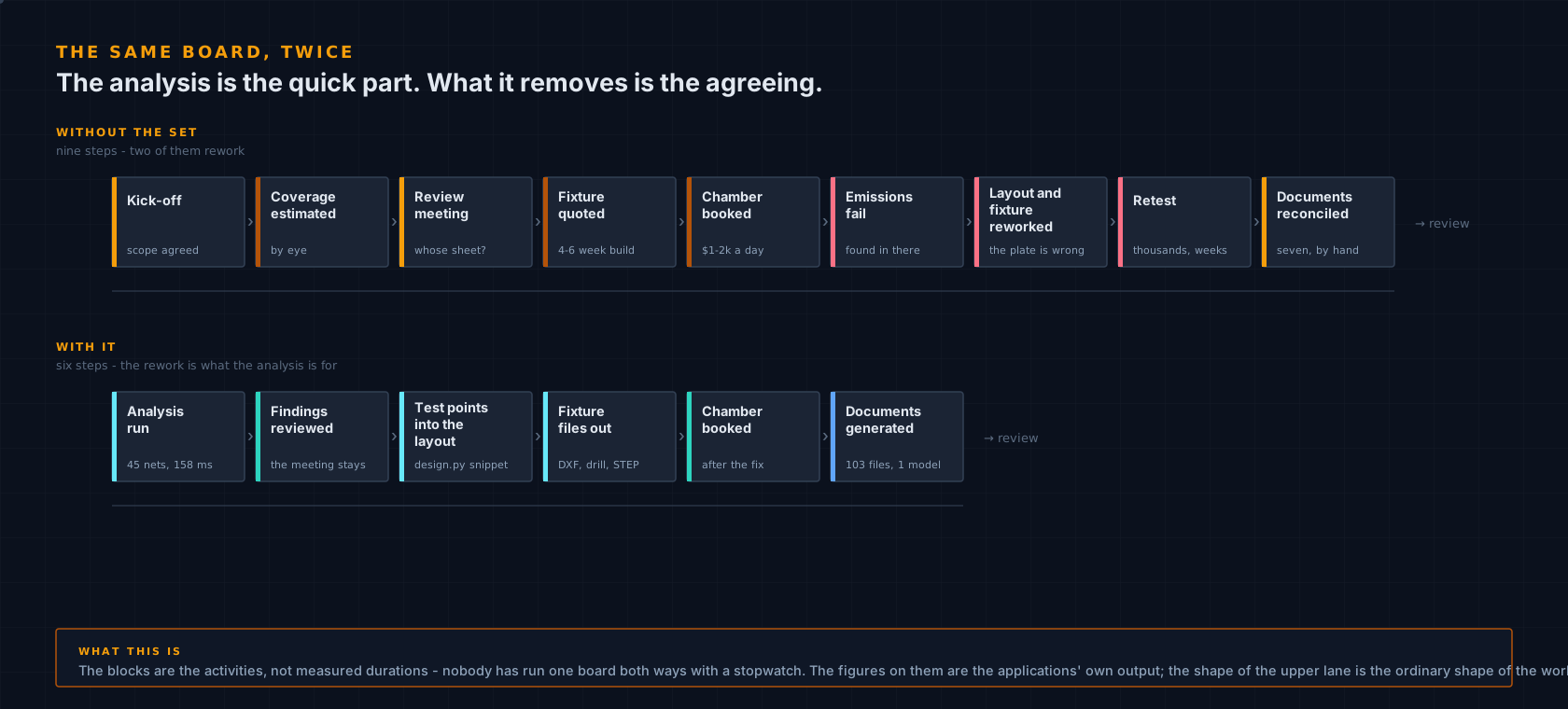
The analysis is the quick part. The agreeing is the quarter.
A test plan, a test specification, per-setup instructions, a DFT report, a risk analysis, a coverage workbook, an equipment list and a project plan. Writing those is a week. Getting seven of them to agree with each other, and keeping them agreeing after the layout moves, is everything else — and it goes almost entirely on meetings, and on finding out whose copy is current. Generated from one model, they agree by construction, and the review becomes a conversation about the findings rather than about the paperwork.
The applications
Fifteen of them, in two groups.
Each has a desktop application and a command line, and installs with the runtime bundled. None of them is sold as a download: they are the tools the work is done with, installed and licensed when an engagement starts. Anything not built yet says so on its own page.

Applications for engineers
MB Lab Dispatcher
Runs all of them in the right order, and merges what comes back.
PCB Test Analysis
Will this board be testable before you cut the fixture?
EMC Design Compatibility
Find the emissions failure on your bench, not in a rented chamber.
Validation Testing
How many samples, which tests, how long, how much.
Test Spec Ecosystem
One traceability model across every document the product has.
KiCad Integration
Let KiCad answer, instead of parsing its files by hand.
EM Solver
Full-wave field solving, gated on whether the mesh deserves trust.
Test equipment
AOI Inspector
Optical inspection that behaves like a bench instrument.
MB Lab Vision
Measuring with a camera, driven like an instrument.
HardwareRTD
A live instrument reading, in an Excel cell — from anywhere.
DataStreamerX
Microsoft's Data Streamer, with the parts it is missing.
SignalScope
An oscilloscope for anything that can send numbers.
MBLT PLC
Program an ESP32 or an Arduino the way you program a PLC.
MBLT HMI
Operator screens on a panel PC, or in any browser on the network.
MBLT Sequencer
A test station: sequences in Python, an IDE with a real debugger, and a verdict per unit.
See all 15, and what each one does — or say in your first message what you need one to do.
On video
Or watch them work.
Every one of these applications has recordings on its own page — the real program, on a real bench, doing the thing the page claims it does. Boards pass and boards fail; an EMC analysis predicts a failure while you watch; a real Arduino's readings arrive in a spreadsheet cell. This is one of them: MBLT Sequencer running a board's functional test, the part picked, the serial scanned, Run pressed, and every measurement filling in against its limits until there is a verdict. The board under test is the simulated bench it ships with, so you could reproduce it with no hardware at all. Nothing plays until you press it.
64 recordings in all, across every one of the fifteen applications — each on its own page. The applications → · The sequencer's ten →

Hardware
The boards the software was written for.
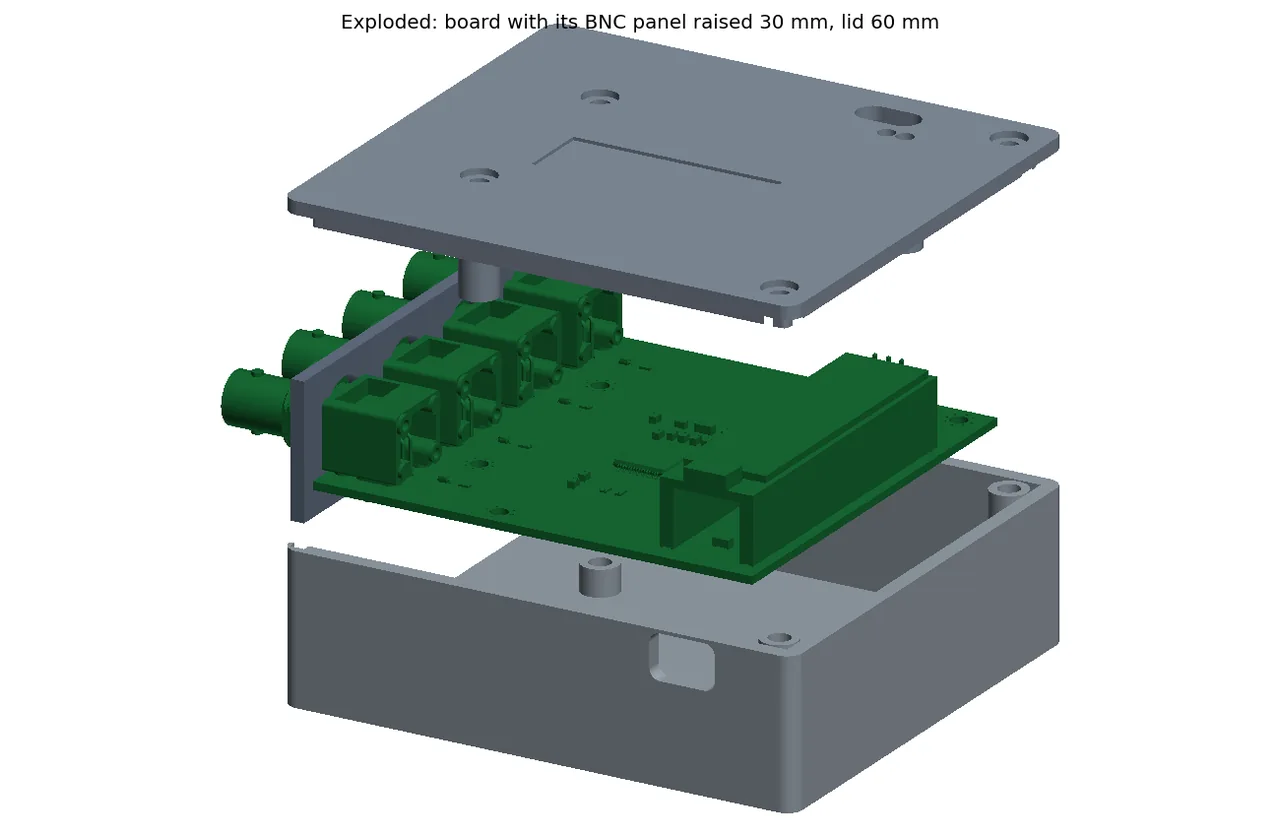
Designed the same way the analysis is run: in KiCad from netlist-as-code, with ERC, DRC and schematic parity as release gates and an LCSC code on every part, so the BOM and the pick-and-place file can go straight to a fabricator.
Where this is going
A low-cost ecosystem for people without a department.
The direction I am sure of is this: the interfaces stay open. Every one of these applications speaks SCPI, Modbus, OPC UA or MQTT, and every one of them describes itself in a manifest any other program can read. You can write against them today, in any language, with nothing bought from me — and the thread between them is worth more if other people's tools can join it than if they cannot.
If you build things for engineers
The limit of this project is that it is one person, and that is the thing most worth fixing. An instrument driver, a test method for an industry I do not know, a board worth adding, a manual that would make one of these usable by somebody who has never seen it — tell me what you would want to build and what you would need from me to make it worth your time.
If it already saved you an afternoon
Support goes towards fabricating the boards, building the test equipment the applications already specify, and a code-signing certificate so an install stops being met by a warning. It does not buy a place in the queue or a private build — if you need something that specific, that is a quote, and a conversation I am glad to have.
Being built now
The set is not only software.
The applications specify a fixture, a sequence, a bench and an enclosure. These are those things being built: the instrument a fixture bolts into, the tester that runs the functional leg, the sequencer that drives it, and the printer that makes the parts. None can be downloaded or bought yet, and none of them has anything to photograph. They are here because each one closes a gap you can already see in the pages above, and because saying what is coming is more useful than letting it arrive as a surprise. No dates — a date I miss is worse than no date at all.
Test equipment
In-circuit test equipmentBeing designed
The tester that the fixture files already describe.
What already exists. PCB Test Analysis already produces the whole fixture from the layout: a machining DXF of the plate, a dimensioned drawing, an Excellon drill file, hole centres as XYZ, a probe list with the net and target of every pin, the push-rod table, the force report, and a STEP model of the plate for the mechanical assembly. Those files go to a shop today.
What is missing. What is missing is the instrument the plate bolts into - the receiver and interface board, the switching matrix, and the measurement front end that reads what the probes touch. It is being designed against the boards on the hardware page, because those are the boards whose coverage has already been analysed.
Test equipment
Automated functional testersBeing designed
The bench that runs the functional leg, built as a unit.
What already exists. The functional test leg already exists on paper: Test Spec Ecosystem writes it out of the trace model as P-FT, with the cases, the limits and the equipment each one needs, and MBLT Sequencer can import that leg and run it. The instruments are reachable already - SCPI, Modbus, VISA, the HardwareRTD engine - and the simulated bench proves a sequence against faults before any hardware exists.
What is missing. The bench itself, as one thing rather than a trolley of borrowed instruments: a modular tester carrying programmable power, an electronic load, a relay matrix for routing, and the sensor and signal simulation a board needs to be exercised. It is being designed around the sequencer that would drive it and the fixtures the coverage analysis already specifies, which is the only reason to build it rather than buy one.
In-house manufacture
Rapid prototypingBeing set up
Enclosures, jigs and fixture plates made here, from the same files.
What already exists. The enclosures on the hardware page are drawn and exported - STEP for assembly, DXF for flat parts - and the fixture plates come out of the coverage analysis in the same formats. Laser engraving and fibre-laser copper ablation for prototype boards are already done in-house.
What is missing. What is being set up is printing them here rather than sending them out: enclosures, probe pods, panel parts, assembly jigs and fixture plates, on a day's turnaround instead of a week's. Until that is running, the hardware page says of every enclosure that it is designed and not yet printed, because it is.
Engineering services
And when you would rather someone just did the work.
The applications came out of twenty years of doing this by hand, and that work is still on offer. One person, start to finish — the person who scopes it is the person who builds it.
PCB hardware design
From a requirements conversation to a fab-ready board.
- Schematic capture, layout, ground and power integrity
- Gerbers, drill, pick-and-place, STEP and 3-D renders
- Costed BOM with sourcing and alternates
- ERC, DRC and schematic-parity checks as release gates
Test engineering & DFT
Designed so it can actually be tested in production.
- Testability analysis and per-component test coverage
- Test point planning for ICT, flying probe and boundary scan
- Bed-of-nails and clamshell fixture design, with drawings
- Test plans, test specifications and traceability
EMC & validation
Finding the failure on your bench, not in a rented chamber.
- Applicable standards by industry and market (FCC, CE)
- Pre-compliance estimates for emissions and immunity
- Environmental and mechanical validation planning
- Sample matrices, test instructions and equipment lists
Build, instrumentation & inspection
The bench work, not just the drawing of it.
- PCBA population, harnessing and enclosure assembly
- Test rig and load box build, wired and verified
- Bench automation and SCPI instrument control
- Machine-vision inspection for assembly defects
Mechanical design, GD&T & fabrication
The parts around the board, drawn so a shop can actually make them.
- CAD for enclosures, brackets, fixture plates and adapters
- GD&T applied properly, so a tolerance means the same thing to you and to the shop quoting it
- Manufacturing drawings, STEP and DXF ready to send out
- 3-D printing in-house for prototypes, jigs and short runs
- Laser engraving, marking and prototype boards cut in-house by fibre-laser copper ablation
- CNC machining managed end to end through partner shops
About
Pavel Banić — principal engineer and owner
I build the tools I needed and could not buy.
Over twenty years in electronics, mechanical and manufacturing engineering — fourteen in research and development, nine in test, nine in manufacturing — mostly in automotive and agricultural equipment, and twelve of them drawing components and fixtures properly, with GD&T.
MB Lab is My Basement Laboratory, which is both a YouTube channel and an accurate description of where all of this started. More about me, and where this is going →

Tell me what you are building.
A board that needs designing, a fixture that needs making, a product that has to pass EMC, or one of the applications that does not quite do the thing you need. Send a sentence or two and I will tell you honestly whether I am the right person for it.