Software
Tools I built for my own work.
Windows applications covering test analysis, EMC, validation, traceability, inspection and live bench data. Each has a desktop app and a command line, installs with the runtime bundled, and writes documents you can hand to someone else. They are not sold as downloads: they come with the work.
Applications for engineers
Design, analyse and plan: testability, EMC, validation, traceability, field solving and the thread between them.
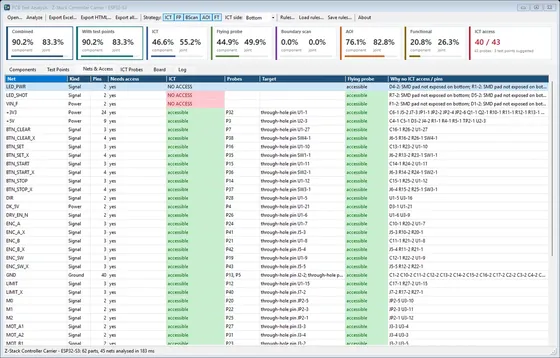
pcbtestAvailable 1.4.2
PCB Test Analysis 1.4.2
Will this board be testable before you cut the fixture?

emcEarly release 0.1.1
EMC Design Compatibility 0.1.1
Find the emissions failure on your bench, not in a rented chamber.
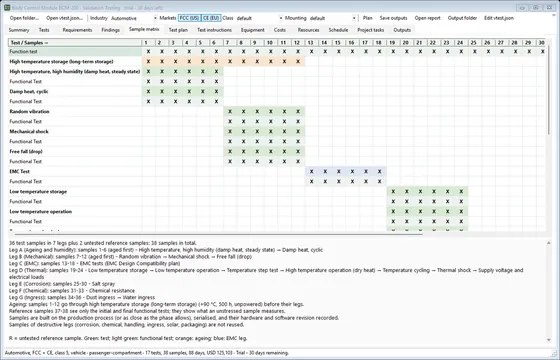
vtestEarly release 0.1.0
Validation Testing 0.1.0
How many samples, which tests, how long, how much.
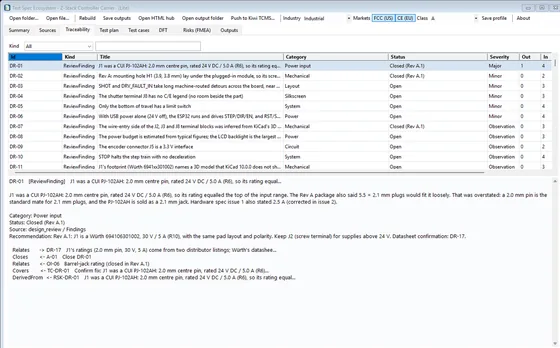
tspecEarly release 0.1.1
Test Spec Ecosystem 0.1.1
One traceability model across every document the product has.
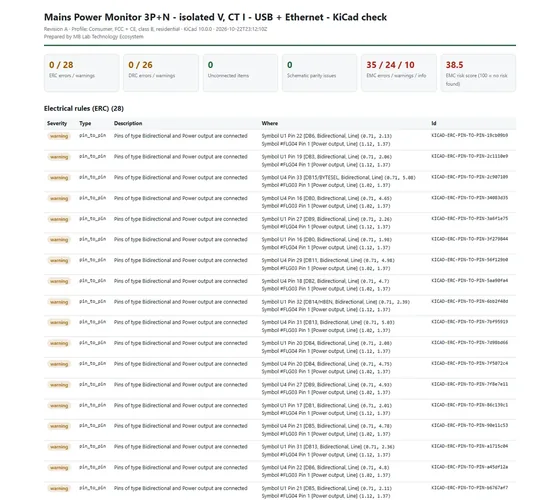
mbkicadIn development
KiCad Integration
Let KiCad answer, instead of parsing its files by hand.
mbctlEarly release 0.1.0
MB Lab Dispatcher 0.1.0
Runs all of them in the right order, and merges what comes back.
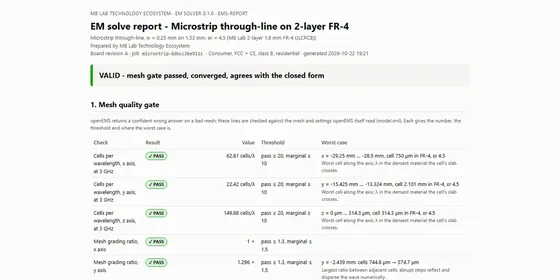
mbemsIn development
EM Solver
Full-wave field solving, gated on whether the mesh deserves trust.
Test equipment
Software that behaves like an instrument on the bench - scopes, inspection, PLC and HMI, and live data into Excel.

aoiAvailable 1.2.1
AOI Inspector 1.2.1
Optical inspection that behaves like a bench instrument.
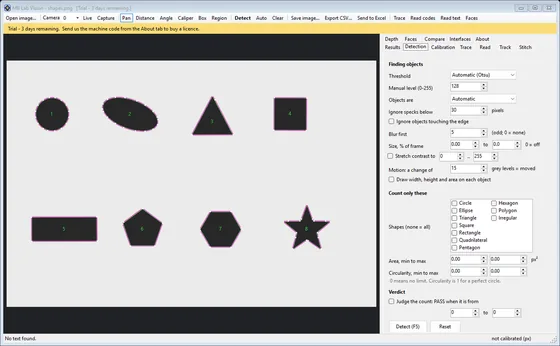
mbvisionEarly release 0.11.0
MB Lab Vision 0.11.0
Measuring with a camera, driven like an instrument.

HardwareRTDAvailable 1.1.0
HardwareRTD 1.1.0
A live instrument reading, in an Excel cell — from anywhere.
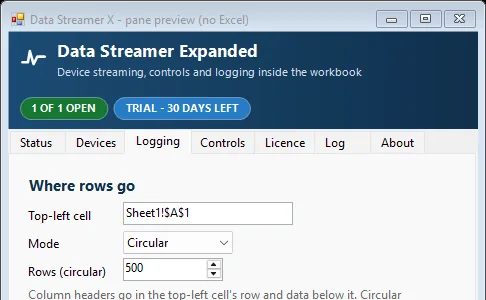
DSXAvailable 1.1.0
DataStreamerX 1.1.0
Microsoft's Data Streamer, with the parts it is missing.
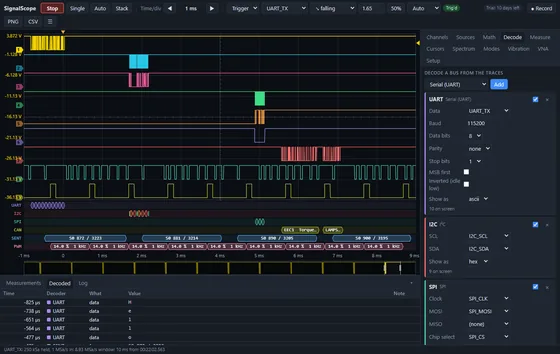
SignalScopeAvailable 1.0.0
SignalScope 1.0.0
An oscilloscope for anything that can send numbers.
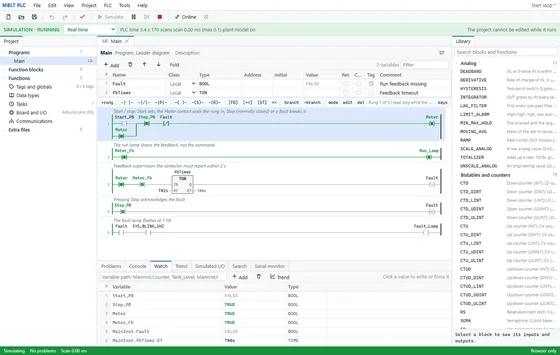
MbltPlcEarly release 0.1.0
MBLT PLC 0.1.0
Program an ESP32 or an Arduino the way you program a PLC.

MbltHmiEarly release 0.1.0
MBLT HMI 0.1.0
Operator screens on a panel PC, or in any browser on the network.
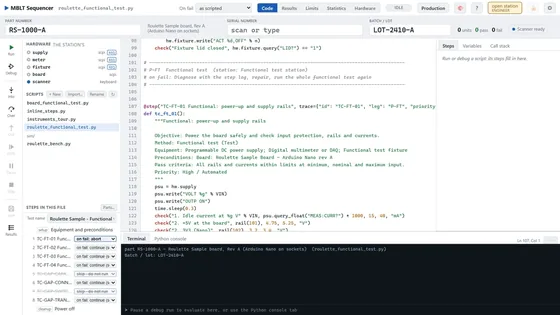
mbseqAvailable 1.0.4
MBLT Sequencer 1.0.4
A test station: sequences in Python, an IDE with a real debugger, and a verdict per unit.
Anything not built yet says so on its own page. I would rather tell you that than let a list of names imply more than there is.
How they fit together
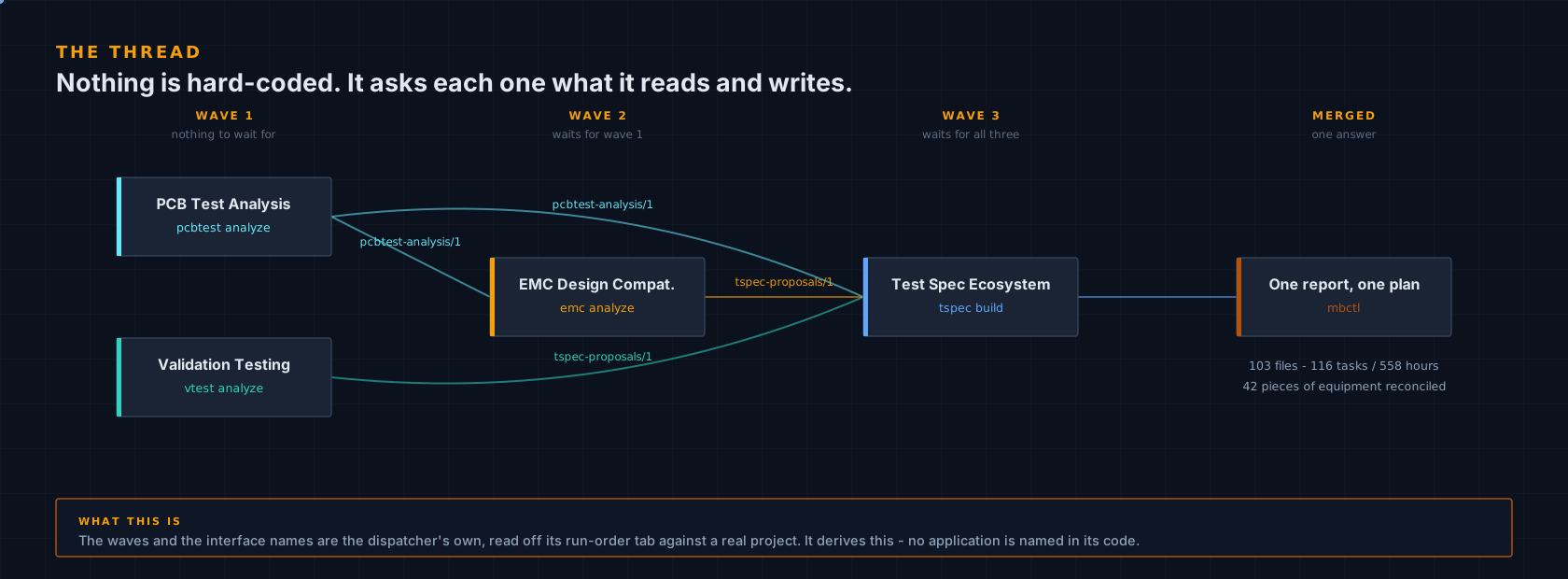
One thread, not a drawer full of utilities.
They share a product profile — industry, markets, product class,
environment — and one project interface, so their outputs merge into a
single Microsoft Project plan instead of a dozen unrelated reports. A
board analysed in pcbtest hands its layout findings to
emc; emc and vtest both propose
test cases into tspec. That thread is the part nobody else
sells.
Being built now
The set is not only software.
The applications specify a fixture, a sequence, a bench and an enclosure. These are those things being built: the instrument a fixture bolts into, the tester that runs the functional leg, the sequencer that drives it, and the printer that makes the parts. None can be downloaded or bought yet, and none of them has anything to photograph. They are here because each one closes a gap you can already see in the pages above, and because saying what is coming is more useful than letting it arrive as a surprise. No dates — a date I miss is worse than no date at all.
Test equipment
In-circuit test equipmentBeing designed
The tester that the fixture files already describe.
What already exists. PCB Test Analysis already produces the whole fixture from the layout: a machining DXF of the plate, a dimensioned drawing, an Excellon drill file, hole centres as XYZ, a probe list with the net and target of every pin, the push-rod table, the force report, and a STEP model of the plate for the mechanical assembly. Those files go to a shop today.
What is missing. What is missing is the instrument the plate bolts into - the receiver and interface board, the switching matrix, and the measurement front end that reads what the probes touch. It is being designed against the boards on the hardware page, because those are the boards whose coverage has already been analysed.
Test equipment
Automated functional testersBeing designed
The bench that runs the functional leg, built as a unit.
What already exists. The functional test leg already exists on paper: Test Spec Ecosystem writes it out of the trace model as P-FT, with the cases, the limits and the equipment each one needs, and MBLT Sequencer can import that leg and run it. The instruments are reachable already - SCPI, Modbus, VISA, the HardwareRTD engine - and the simulated bench proves a sequence against faults before any hardware exists.
What is missing. The bench itself, as one thing rather than a trolley of borrowed instruments: a modular tester carrying programmable power, an electronic load, a relay matrix for routing, and the sensor and signal simulation a board needs to be exercised. It is being designed around the sequencer that would drive it and the fixtures the coverage analysis already specifies, which is the only reason to build it rather than buy one.
In-house manufacture
Rapid prototypingBeing set up
Enclosures, jigs and fixture plates made here, from the same files.
What already exists. The enclosures on the hardware page are drawn and exported - STEP for assembly, DXF for flat parts - and the fixture plates come out of the coverage analysis in the same formats. Laser engraving and fibre-laser copper ablation for prototype boards are already done in-house.
What is missing. What is being set up is printing them here rather than sending them out: enclosures, probe pods, panel parts, assembly jigs and fixture plates, on a day's turnaround instead of a week's. Until that is running, the hardware page says of every enclosure that it is designed and not yet printed, because it is.